Memory of a Fine Spring Salmon

Photo: MEMORY OF A FINE SPRING SALMON</p><br /><br /><br /><br /><br />
<p>I was looking through some photographs of salmon caught at Finavon during 2013 and found the one in the picture (photo taken with a mobile while keeping the salmon in the water to release it safely: hence the poor photo!). This 17lbs spring salmon was caught by John Wood in the Beeches on a very small Willie Gunn in April 2013.</p><br /><br /><br /><br /><br />
<p>These early running salmon arrive in the pools of Finavon Castle Water any time from March onwards. The best time to fish for them is when the water temperature starts to climb in April and into May. All these early arrivals are multi sea-winter salmon which means that they stayed at sea for more than one winter. Multi sea -winter salmon feed far away from Scotland's shores, unlike our grilse (one sea-winter salmon) which tend to feed near Iceland or in the Norwegian Sea. </p><br /><br /><br /><br /><br />
<p>This beautiful two or three-winter salmon, fresh from the sea and in prime condition, probably spent nearly two years in the fjord waters of west Greenland where there are huge quantities of prey species, including squid, pipefish and capelin. When they are ready to return to their native river, after putting on kilos of muscle and fat, these fish leave the Greenland coast and swim all the way back across the Atlantic Ocean - a distance of more than 2,500 miles - and back into their native river.</p><br /><br /><br /><br /><br />
<p>These multi sea-winter fish are in short supply, and their numbers continue to decline. They are far and away the most valuable group of salmon and command huge prices (up to £60 per Kg) at Billingsgate and in city restaurants. The fact is that for every 100 smolts (small & young salmon leaving fresh water for the first time) that leave their native river only about 5 return as adult fish. The rest die at sea. </p><br /><br /><br /><br /><br />
<p>It is ironical that, at the time when Scotland is producing more than 150,000 tons of farmed salmon, a very small number of people are legally still killing wild spring salmon in coastal nets, and in the process endangering their very existence. Isn't it time the law was changed? Shouldn't there be strict quotas at the very least? Or shouldn't we grasp the nettle and close down the most fragile fisheries completely (rods and nets)?</p><br /><br /><br /><br /><br />
<p>Anglers at Finavon carefully return all these salmon alive to the river. They represent the future. They are our broodstock. They are also the most beautiful fish it is possible to imagine! I leave the following question hanging in the air..."shouldn't we be leaving these fragile spring fish to enter their rivers without any threat of rods or nets to hinder their progress to their spawning locations?"</p><br /><br /><br /><br /><br />
<p>TA 3/1/2014
17lbs salmon caught in Beeches Pool in April 2013 by John Wood.
I was looking through some photographs of salmon caught at Finavon during 2013 and found the one in the picture (photo taken with a mobile while keeping the salmon in the water to release it safely: hence the… poor photo!). This 17lbs spring salmon was caught by John Wood in the Beeches on a very small Willie Gunn in April 2013.
These early running salmon arrive in the pools of Finavon Castle Water any time from March onwards. The best time to fish for them is when the water temperature starts to climb in April and into May. All these early arrivals are multi sea-winter salmon which means that they stayed at sea for more than one winter. Multi sea -winter salmon feed far away from Scotland’s shores, unlike our grilse (one sea-winter salmon) which tend to feed near Iceland or in the Norwegian Sea.
This beautiful two or three-winter salmon, fresh from the sea and in prime condition, probably spent nearly two years in the fjord waters of west Greenland where there are huge quantities of prey species, including squid, pipefish and capelin. When they are ready to return to their native river, after putting on kilos of muscle and fat, these fish leave the Greenland coast and swim all the way back across the Atlantic Ocean – a distance of more than 2,500 miles – and back into their native river.
These multi sea-winter fish are in short supply, and their numbers continue to decline. They are far and away the most valuable group of salmon and command huge prices (up to £60 per Kg) at Billingsgate and in city restaurants. The fact is that for every 100 smolts (small & young salmon leaving fresh water for the first time) that leave their native river only about 5 return as adult fish. The rest die at sea.
It is ironical that, at the time when Scotland is producing more than 150,000 tons of farmed salmon, a very small number of people are legally still killing wild spring salmon in coastal nets, and in the process endangering their very existence.
Isn’t it time the law was changed?
Shouldn’t there be strict quotas, at the very least?
Shouldn’t we close down the most fragile fisheries completely (rods and nets)?
Anglers at Finavon carefully return all these salmon alive to the river. They represent the future. They are our broodstock. They are also the most beautiful fish it is possible to imagine! I leave the following question hanging in the air…”shouldn’t we be leaving these fragile spring fish to enter their rivers without any threat of rods or nets to hinder their progress to their spawning locations?”
TA 3/1/2014

Winter work at Finavon

These bulletin blogs represent news about Finavon and the South Esk, and my views as a riparian owner. While I may digress at times to write about other places, these are not the views of any other organisation, nor are they designed to promote the interests of any individual or organisation other than Finavon Castle Water and factors affecting the fishery. Tony Andrews

Indies Hut

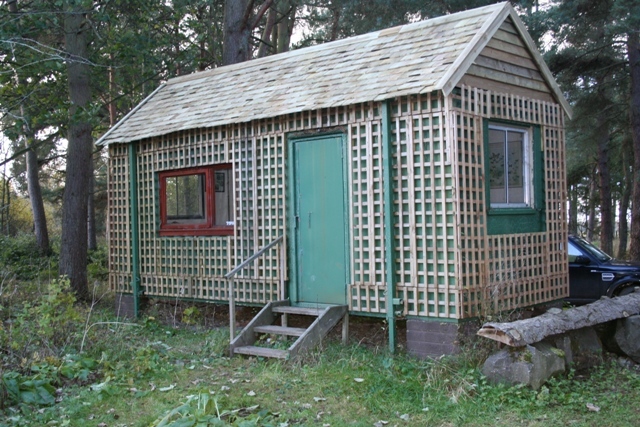
Before: Indies Hut with its flat roof. We decided to make it look less like a container and more like a proper hut, so we painted the flat, rusting and potentially leaky roof with a gooey bitumen paint after cleaning it up a bit. Then we erected a light-construction roof with hand-cut larch shingles. The result is below, and I think adds a bit of rusticity yto the hut, as opposed to the ambience of a badly camouflaged container port.

IMG_9632

After: Indies Hut with its new shingles-clad & pitched roof. When eventually the honeysuckle grows up the trellis surrounds I am hoping you would never know that underneath all the camouflage lies a bog-standard ship’s container!

Winter work is all about maintenance and improvements. The modern angler expects to have shelter – a place to get out of the rain and wind, or a place to snooze during a night’s sea trout fishing. It is no longer acceptable for people to pay rents and find themselves fishing out of the boot of their car! Finavon Castle Water prides itself on the whole experience, of which fishing for salmon and sea trout is the most important part. So, we sell the experience of being in a beautiful place with simple, modern facilities and the chance of a fish. We do not sell fish by numbers, although there are occasions when the South Esk can be generous!

The 4 huts at FCW, one on each of the 4 beats, are sited to give our visitors a special view of the river. Vehicle access and parking is adjacent to the huts and the location of each is private and exclusive. Actually, the setting of all 4 huts can be rather romantic, depending of course on what your inclinations and stage of life may be!

TA

What a way to run a country!

These bulletin blogs represent news about Finavon and the South Esk, and my views as a riparian owner. While I may digress at times to write about other places, these are not the views of any other organisation, nor are they designed to promote the interests of any individual or organisation other than Finavon Castle Water and factors affecting the fishery. Tony Andrews

I saw the post below on the Salmo Proboards Forum and thought it so apposite to the current situation on the Esks that I thought I could do no better than quote it in full in one of my bulletin blogs.

The author calls himself/herself ‘Adipose’ and this is what Adipose wrote:

“Very few fishery owners make money from letting their fishing. Costs of managing  a rod fishery are huge and rents, especially on beats showing average catches of  less than 150 salmon each year, are insufficient to cover those  costs.

Let me give you an example of one 150 average catch fishery I know  on the South Esk

Annual rent from all sources is just under £20,000

Fishery Board levy £8000
Maintenance and cleaning of huts £1500 – £2500
Cutting of grass paths and maintenance of pools £5000  +
River watcher and Ghillie wages about £8000

The owner, who manages  to let a good proportion of the available weeks at an average of £60 per rod  day, ends up subsidising the people who come to fish. But he doesn’t resent  doing that (see below).

So why would someone do that? Why would they  knowingly lose money? The answer is very simple (and I am now thinking of three  owners on well known east coast rivers). They enjoy managing a fishery, living  close to the river, meeting their visiting fishers, looking after the natural  riverside environment and wildlife. it is a way of life. None of the three  people I have in mind wants to make a quick buck. Nor do they want to sell their  beats and benefit from the very considerable capital locked up in their  property. Actually, the only possible profit they might make would come from  selling their beats. And then they would have lost their way of  life.

Isn’t it a wonderful thing that there are idiots around who are  prepared to look after our rivers and lose money in the process? Most of these  beats are well looked after too!

It is an absolute myth that riparian  owners are “pocketing” huge amounts of cash. There is no such cash available,  except on the very few big river or famous premium beats. If you disagree with  me please give me examples and amounts of money involved. I think you will find  it hard to find a single example of profiteering by riparian owners on ‘modest  beats’ (150 salmon per year average).

Now, let’s put that scenario in the  context of what the netting interests are doing:

Their levy is far less  than the riparian owner’s levy. why?
They reap huge amounts of money from  selling dead spring salmon. In May 2011 Usan Fisheries killed 2307 salmon worth  over £300,000. Just one month!!! If you want to know who is profiteering from  our salmon you need look no further. The Usan company employs very few people,  pays very little money to conserve salmon and sea trout and kills 100% of their  catches.
What a way to run a country!”

Read more: http://salmo.proboards.com/posts/recent#ixzz2knjQjkyh

It is time for riparian owners and angling club owners/long lease holders to retaliate for all the first-nation-type (you know the argument: “we are Scotland’s poor, working class workers being exploited by the super-rich toffs & foreigners”) garbage propaganda being pedalled by the netting community!

Perhaps, if anyone agrees with me, they should let me know. Maybe we should mount a campaign of truth? I say that because the Scottish Government is either being duped by, or is conniving with, the propaganda which is ‘un peu economique avec la verite’ as my schoolboy French might have it.