Spring Salmon at FCW

A PERFECT 14lbs SPRING SALMON FROM TYNDALS POOL!
After a long morning in the office I took the two dogs for a walk down Milton Beat, where Derek was fishing through Tyndals Pool. When I first saw him he was in the middle of the lower part …of the pool, which I thought was a bit strange. It was only when I got close to him that I realised he was quietly leading a large salmon down the pool towards Willows where he was planning to land the fish.
Derek's 14lbs salmon Derek with 14lbs salmon from Tyndals DS with 14lbs salmon
This 14lbs spring salmon was caught and returned on Milton Beat (Tyndals to Willows) on 3 April 2014.
Derek told me that he had been too lazy to change the leader from the 8lbs nylon he had been using in the bright sunny days of last week. He wanted to be fishing with at least a 12lbs cast. He was therefore playing the salmon with some care, and at that point he had not seen the fish, despite the clear and lowish water. From my position on the high bank above I could see the dark tail and grey form of the salmon’s body. It was clearly a well-built fish.
But we soon did see the fish, and it was obvious that it was a fine salmon in the teens of pounds. No net was available and my camera had packed up, so we agreed that I would use my mobile phone and Derek would do the honours. Gradually the salmon tired. We could see its broad back and silvery, violet sheen flanks as it rolled onto its side. Its broad, delicately forked tail broke the surface and the fish came quietly to the side opposite the willows at the head of the Boat Pool. What a beautiful fish! Derek gently removed the size 10 Willie Gunn from the scissors of the hen fish, which we estimated was about 14lbs in weight.
After some point-&-press mobile camera shots the salmon lay quietly in the flow beside some rocks before quietly swimming away into the deeper water at Willows.
For me this fish represents the very best of Finavon in the spring. There is something deeply consoling about knowing that such a fish can exist and return to our little river, despite the uncertainties of climate change and the obstructions and other challenges we human beings put in its way.
It is only 2 April. If there is enough water the South Esk may show us all what this fine little river is capable of producing in the spring. There really is hope, but guarded hope of course!
God speed, you fish! Do your duty. Lay your 7,000 ova in the high burns of the South Esk’s upper catchment. Confound the sceptics and show us how resilient you and all your companions returning to our shores from the Greenland fjords can be.
TA

FCW Facebook ‘Likes’ now over 4000

I have been amazed by the strength of interest shown in our little fishery on the South Esk – Finavon Castle Water. This support has encouraged me to write on a whole range of topics in these posts, and the more diverse they have been, the more likes have been registered.
Christy Balcombe and Tally at DTH rs
David’s Tree House (DTH)
Looking after a fishery is a fascinating and complex task which requires a balance between providing access to our visitors (whatever their interest), and conserving the natural environment of the river and its surroundings. I wouldn’t be able to do any of these things without my team of helpers, including Will & Jo Wells of Scottish Oak, Derek Strachan  and Angus Tree Surgeons, and my new assistant on the river banks keeping the pools fishable, Iain MacMaster. These people are the team that eradicate invasive weeds such as giant hogweed and Himalayan balsam, trim obstructing foliage, coppice and plant trees, remove litter, clear up flood debris, clean and supply the four huts and the Treebog, cut the grass paths, carry out safety checks, and paint huts and bridges woodwork with cuprinol etc.
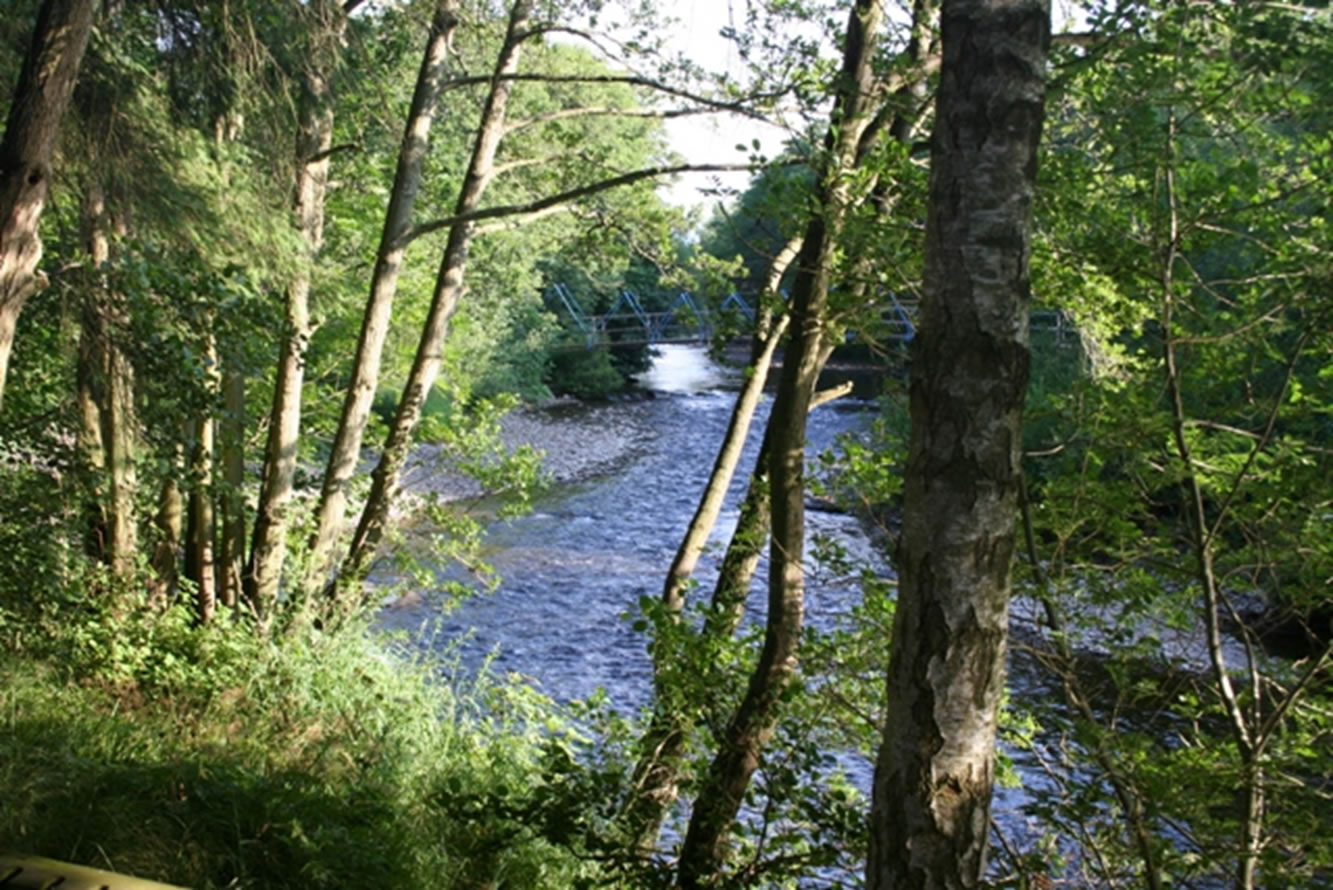
Early autumn view in low water from the Red Brae Hut.
Simon Walter, our web designer, keeps coming up with great new ideas and products, such as the new booklet, pool-by-pool fishing guide for anglers without a ghillie. The website Simon has created is widely recognised as a model of how to promote a fishery!

IMG_9632

Indies Hut
Before we developed our Facebook pages and website our local fishing tackle retailer, Angus Angling, did much to raise the profile of FCW, especially in the period immediately after the rejoining of Fortesk with FCW in 2008. Angus Angling is one of Scotland’s best tackle shops and I am hoping that the new Lochlands Game Fishing Enterprise next to the A90 will attract visitors into the town. Two tackle retailers in the town is as it was and should be, especially if we can siphon off some of the passing traffic. Who knows? the critical mass thus achieved may make Forfar a destination for anglers in much the same way as Penrith has become. One only has to think of all those great rivers north of Forfar up the A90 to realise that there must be hundreds of anglers passing through. They now have a reason to stop. We must build on that.
Icicles and a 36F river in late March
Icicles and a 36F river in late Marc
Red Brae Hut
There is also a group of local people who fish FCW pools regularly and who give their time willingly if there’s a job to be done (like clearing rubbish from the Lemno Burn). Moray Macfarlane is our preferred ghillie/guide, who operates on a freelance basis and acts as syndicate coordinator.
Exif_JPEG_PICTURE
Treebog
Finally, but far from least, we have our developing relationship with Lochlands Game Fishing in Forfar, and the support of Ryan Balcombe, and the Lochlands owner, Phil Ritchie, and his lovely family.
Bogardo Hut
Interior of Bogardo Hut
I reckon that about 250 different anglers fish for salmon and sea trout at FCW each season, and another 250 enjoy the natural surroundings, not to mention my family and friends who love a BBQ on a summer’s evening, or a cosy bowl of soup in the warmth of David’s Treehouse on a chilly autumn day. Our 4,000 + likes are effectively spreading the word about the delights of coming to FCW to fish, or just to enjoy the river and its surroundings. Thank you again for your interest.
TA

The new Season: 2014

February the sixteenth this year was a Sunday, so no-one fished on that day. On Monday Moray caught a well conditioned kelt in Haughs Pool (immediately below the old pipe bridge) and on Thursday Ian Mac Master caught a thin but well restored grilse kelt in the Flats (Milton Beat). No frersh salmon have been seen yet.

Grilse Kelt from the Flats on 21 Feb 14

A well-mended but very thin grilse kelt caught and returned to the river in Flats on Milton Beat. The ‘belt-like’ profile, distended vent, oversized head and hard bright silver colour are characteristics of spent salmon (kelts) easily seen in this photo by Ian MacMaster. Closer inspection would most likely reveal the presence of gill maggots. It is good to see the fins of this fish in such good condition. Unfortunately, very few of the South Esk’s salmon kelts live to return to the river to spawn again. Those that do (a lot less than 10%) are nearly all female.

The South Esk is in excellent ply, with clean gravels and manageable levels of repair to banks needed after a series of moderate spates – nothing approaching the disastrous floods of further south. I feel we have escaped lightly.

Rubbish clearing

Some of the rubbish collected by the Scottish Oak Team last week from FCW riverbanks and woods after the winter floods. This was the result of a one-day clear up. One of the issues for anyone managing a river beat is that people throw their rubbish into the river – including on one memorable occasion a full-size blow-up Japanese (female) doll – which can ruin the feeling of wild natural environment that a river should have in its riparian setting. We spend a lot of time removing the junk and detritus of our ‘civilisation’.

The situation with the Usan nets, as I mentioned in an earlier blog, now needs resolving – at the very least to sort out the issue of nets killing fish during slap periods and the close season. We should not allow a situation where the law is being ignored (or worse) to damage the South Esk’s wild salmon and sea trout stocks. At present it most certainly is.

There may now be signs of official movement, with a legal process starting, a national review of freshwater angling management, another assessment of the value of Scottish freshwater angling to the economy and an ongoing focus on the South Esk by Marine Scotland and SEPA. In the background, but most importantly, the River’s SAC status makes it a priority in terms of the two qualifying species – Atlantic salmon and the freshwater mussel.

You would have thought that all this research and other activity might have resulted in more targeted conservation action. Not yet I’m afraid.

TA