LATE JUNE SEA TROUT REPORT

END OF JUNE. ARE THERE MORE SEA TROUT TO COME?

We have been tickling away all week with one or two sea trout each night, after the six we caught on Monday. There are sea trout in all the pools, but not many.

I am interested to see whether the main run is yet to come because, by any measure, this has been a strange year with warm water from the beginning of the season and sufficient water in the  river to allow sea trout and salmon to swim upstream without any problem.

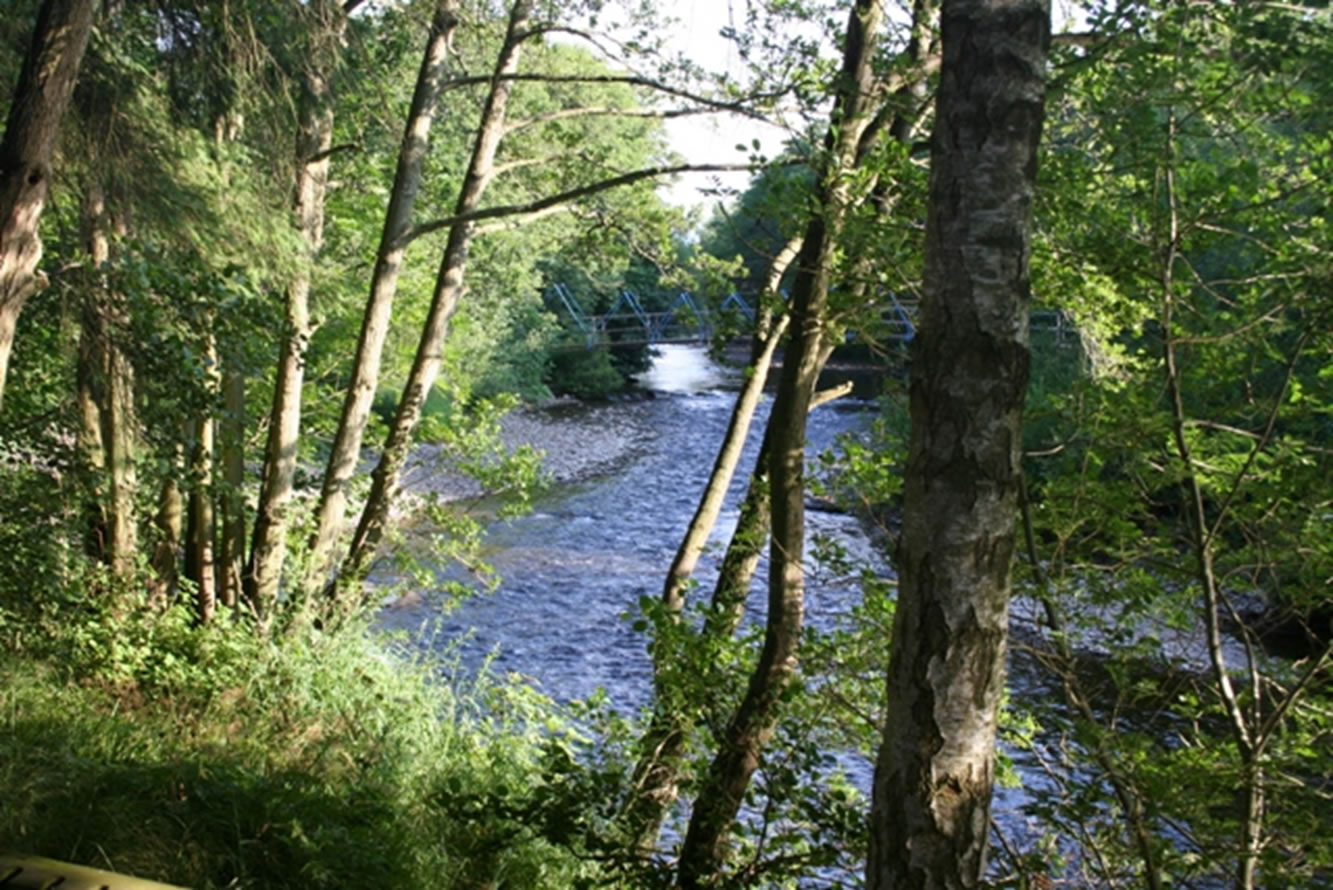
fishers down the Flats

This photo was taken from the suspension bridge at the tail of Casdtle Stream, just above Red Brae. You are looking upstream towards the Flats where there are two peopole fishing.

Conditions at night are now perfect for the night angler. If there were shoals in the main pools we would probably be catching them in good numbers, but those shoals, as far as we have observed, are only intermittently present.

I remember a night in 1988 when I ‘found’ a shoal of sea trout in the tail of Tyndals Pool at about 0200 and caught seven of them before the dawn came. I had not seen those fish lying on the gravel in daylight. It is possible that they had arrived during the hours of dusk ness (there’s no darkness in June in Scotland) but I think not. That shoal of sea trout in my opinion had been there all the time, just lying quietly in the quiet tail of Tyndals.

Which just goes to show that sea trout are mysterious and secretive fish that keep themselves to themselves, and normally are very difficult to spot.
Postscript written at 0630 on 30 June 2014

THE RIVER DROPS AND WE ARE IN THE DOLDRUMS
As the South Esk falls away to its summer low level the movement of migratory fish into and within the catchment has declined.
As always with our little river, we now need rain to freshen up the system and encourage new fish, fresh from the sea, to enter the river.
Until that happens I suspect all will be very quiet.
I see that some rain is forecast for later in the week. By then we will be needing it badly.
The season to date at FCW has seen 37 salmon (biggest 16lbs) and 46 sea trout (biggest 5lbs) recorded.
TA

Imagine…….

155,000 escaped chickens invade the Vale of Strathmore”

Just imagine if that were true!!

Over 300,000 lbs of live battery chickens running around wild, defecating and swamping the countryside….

The difference between that and what we are doing in the sea off the west coast and islands of of Scotland is that a) chickens don’t interbreed with populations of wild birds b) we can see the chickens and the mess they make c) as far as we know escaped farmed chickens don’t cause disease or mass explosions of parasites.

If the countryside around Forfar were suddenly to be inundated with 155,000 battery chickens you might expect there to be complaints in the press and live media. In fact I would expect there to be a major public objection. SEPA and SNH would get involved and those chickens would be recaptured very quickly. Moreover the farmer whose poor biosecurity allowed this massive escape to happen would most likely be charged, lose his licence, fined and put out of business.

In the last few years 2.7 million farmed salmon have escaped from their open-mesh (“string vest”) cages in Scotland’s once pristine northern waters. Most recently 155,000 salmon have “escaped” from a salmon farm in Shetland. But, because noone sees them, as they would those escaped chickens, those massive escapes of farmed salmon go unseen and largely unremarked.

When battery hens are in their coops, all the effluents are treated and regularly monitored. Not so the effluents from open mesh salmon cages. Untreated raw sewage from millions of caged salmon close to the beaches and coastal villages of our islands and west coast communities are poured into the sea in huge quantities, along with uneaten food, and chemicals for treating disease and parasites. It is no exaggeration to say that these salmon are literally growing in their own shit, reminding me of the quote by WC Fields who said “I don’t drink water. Fish fuck in it”!

Please think hard about the way we grow our farmed salmon in the sea. Do the salmon farming companies’ balance sheets reflect the massive freebie they get by not processing their waste, as every other farmer in the country is forced to do by law? Can our seas really absorb all that crap? If salmon farmers are getting that freebie, who is really paying the bill in lost biodiversity, pollution and visual spoiling of our wilderrness coastline – certainly impacting on tourism?

Even the most unscientific of us will realise on the basis of common sense that you cannot swamp the fragile ecosystems of those northern inshore waters with those levels of effluent without there being collateral damage. Any farmer will tell you that. The Kentucky dust bowl disaster of the 1930s is an example of where greed & profit overides common sense and good husbandry. No Wizard of Oz to help the beleaguered Scottish west coast!

Because the destruction is happening below the surface of the sea, it is out of sight and out of mind. How very convenient that is to their accountants, who tot up the profits and present the balance sheets! How different those accounts would look if the real costs of treating the sewage from salmon farms were included.

That is why I keep banging on about Closed Containment salmon farming. It is not ideal I know. Any form of animal farming in such huge amounts is far from the world of the hunter/gatherer, who could kill and eat an animal from its natural environment. But we have to find sustainable methods of providing protein at a reasonable price for 7.5 billion people living on this planet. Aquaculture is the way forward, but not at any price.

Please support AST and its partners in promoting closed containment salmon. It tastes better, it doesn’t pollute the beaches, it doesn’t infect wild salmon & sea trout with disease and parasites, nor does iot threaten wild salmonids with inter-breeding.

I would rather have the 155,000 battery chickens!

TA
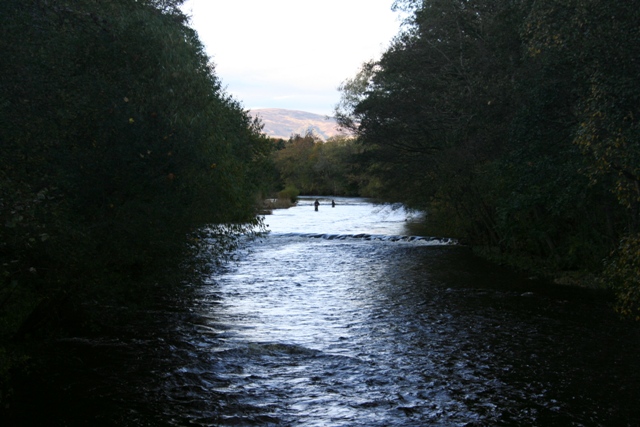
October water, some leaves and a few fish

These bulletin blogs represent news about Finavon and the South Esk, and my views as a riparian owner. While I may digress at times to write about other places, these are not the views of any other organisation, nor are they designed to promote the interests of any individual or organisation other than Finavon Castle Water and factors affecting the fishery. Tony Andrews

As we move into the last three weeks of the 2013 season it only takes a glance at the SEPA graphs of water levels in the South Esk since May to realise that this summer has been a dry one. In fact it has been the driest for more than 30 years.

October fishing party at FCW.
Sitting L>R: Mathew Brown, James Horne, Peter Bentley, Oliver Reeve
Behind them their guide, John Wood.

It is therefore not surprising that fish have been hard to catch. They have also been hard to see, except in bright sunshine when their shadows and shapes were discernible against the pale tones of the river bed gravel. The truth is that there have been reasonable numbers of both salmon and sea trout throughout the four and a half months of mainly low water levels. In a previous blog I wrote about a July visit by Colin Gibb and myself to the Boat Pool where we observed hundreds of sea trout lying doggo in the main dub of the pool. Since then there has been a constant changing of the guard as fish moved into the lies immediately downstream of the Haughs Aqueduct, and then moved on – to be replaced by another group of fish, a mixture of grilse and MSW salmon, interspersed with diminishing numbers of sea trout as the autumn advanced.

Autumn grasses at the Boat Pool

Talking of sea trout, it is good to see a lot of spawning activity in Willows and the glide above Volcano, where more than 40 redds can be seen. Those two locations have long been favoured spawning beds for our sea trout, and it is encouraging to see a good level of regeneration continuing.

Oliver Reeve fishing Tyndals Pool

We had a small freshet last weekend which washed away some of the algae and accumulated debris in the margins of the river, but it brought very few fresh salmon into the river. It was more a juggling of what was already in the river than an introduction of newly arrived salmon. But that changed yesterday (Friday) with Peter Bentley catching a 6lbs silvery cock grilse from Beeches on Castle Beat, having caught and returned a 6lbs grilse in Volcano on Thursday and another one of the same size, also in Beeches. Peter is a skilled angler who fishes quietly and accurately, and catches fish as a result.

Peter Bentley’s 6lbs grilse caught & returned in Volcano

So there are fish about, not in great numbers but they are there. A feature of fish behaviour this year has been how seldom fish have shown by breaking the surface. We have had to search for them using Polaroid glasses and peering into the pools in daylight. There have been occasional flurries of fish showing, but generally these have only been for a few minutes, perhaps prompted by subtle changes in atmospheric pressure.

Early autumn view in low water from the Red Brae Hut.

As write this on Saturday the 12th of October the FCW total of salmon and grilse for the 2013 season stands at 40 and sea trout at a paltry 24. It has not been a good fishing season. There have been weeks on end when effort has dropped away to extremely low levels, with some weeks of zero effort. Never mind; I keep saying to myself that such summer weather is not unusual, or at least it used not to be so. Perhaps we have been lulled into thinking that every summer is guaranteed to be as wet as the last five have been. My memory doesn’t need much jogging to recall a number of dry summers, although none as extensively so as this one. We just need to remember that we are dealing with wild species in a natural resource influenced by a varying climate. Nothing new in that.

The familiar view of the webcam boulder – “The Armchair” – during the long dry summer of 2013

I shall write soon about the importance of measuring fishing effort in the context of our use of catch returns as a measure of abundance. On a small river such as the South Esk, which, when the water level is low, is a clear water stream, effort is more than simply counting up the number of rod days. We need to draw in a number of other factors, including angling method, skill level of the angler, local knowledge, the time of year and hours spent on the river. Whatever formula we eventually reach cannot be any more than an impression of effort, but at least it might indicate a trend…

TA 13/10/2013