Archive for the ‘Notes and Queries’ Category

Late Winter Report from Finavon

Friday, February 26th, 2010

Like everywhere else in Scotland, this has been a long and cold winter. After the massive floods of November and early December, which should have seen most salmon reach their spawning locations, the weather closed in and the temperature dropped. The result was nearly ideal conditions for spawning and, because river levels have remained quiet (as opposed to a raging torrent) the redds should have been undisturbed to allow the fertilised eggs to gestate in the gravel. The season opened on the 16th of February, and we hear of at least two nice fish (c. 14lbs) caught and returned at Kinnaird, which is about 9 miles downstream of Finavon.

The river is in tremendous ply, with the water clean and clear and the bed of the river washed clean by the floods. In places there is some damage, mainly to the banks, but very little change to the depth of the main holding pools. An interesting snippet of news just before the season opened was a report from Steve Hawkins, the river board’s bailiff for the South Esk, that he had seen a pod of early running salmon in the 5-7 lbs weight range running through the Flats on Milton Beat at Finavon. As far as we know, these are the only early fish seen on either the South or the North Esk rivers above the dams at Kinnaird and Morphie respectively.

People who fish regularly here ask me what the omens are for 2010. I can only guess that another cold winter will have done no harm to the availablility of prey species in the coastal zone for sea trout. In cold winters, like this one, both zoo plankton and phyto plankton benefit from very cold water temperatures - in much the same way as in the arctic and antarctic regions, where there is such a phenomenal supply of food for pelagic species of fish. If I am right, and I am not a scientist so my comments are at best an educated guess, we may well see increased numbers of sea trout in June, July and August 2010. Finavon is really best known for its sea trout and in the not-so-distant past we could expect catches of 300+ sea trout averaging 2lbs 10oz. It is becoming likely that we will see a return to such numbers and quality of sea trout.

As far as salmon are concerned the picture is mixed. Our grilse vary hugely in condition and there is a worrying trend for two sea-winter salmon (2SW) to return to the river under-weight. Some early running 2SW salmon have weighed as little as 4lbs. Something is wrong in the South Norwegian Sea in terms of availability of food for salmon and grilse. The issue is complicated by the fact that not all our returning salmon and grilse pass through the S Norwegian Sea. Generally it is true to say that the condition of fish avoiding that area is better than those using it as a staging post on their return. The NASCO and Atlantic Salmon Trust’s research into the lives of salmon at sea may reveal what the problem is.

As I write this bulletin on the 26th February, the snow is still falling and the high corries, where the South Esk rises, are packed full of ice and snow. We can expect a long thaw, perhaps well into May. If there are spring salmon to be caught they should have sufficient water to enter the river. A long cool spring is exactly what we now need! Meanwhile the nets South of Montrose start operations in May, but they have promised not to kill any sea trout for selling to the fish markets. We therefore have genuine optimism that we will see more fish entering the river, and less being killed by the netsmen. Our responsibility as anglers is to kill the very minimum number of fish. If we can ensure that good numbers of salmon and sea trout reach the redds to spawn, we will have made a big contribution to their conservation.  Restraint and good husbandry are the order of the day!

Tony Andrews

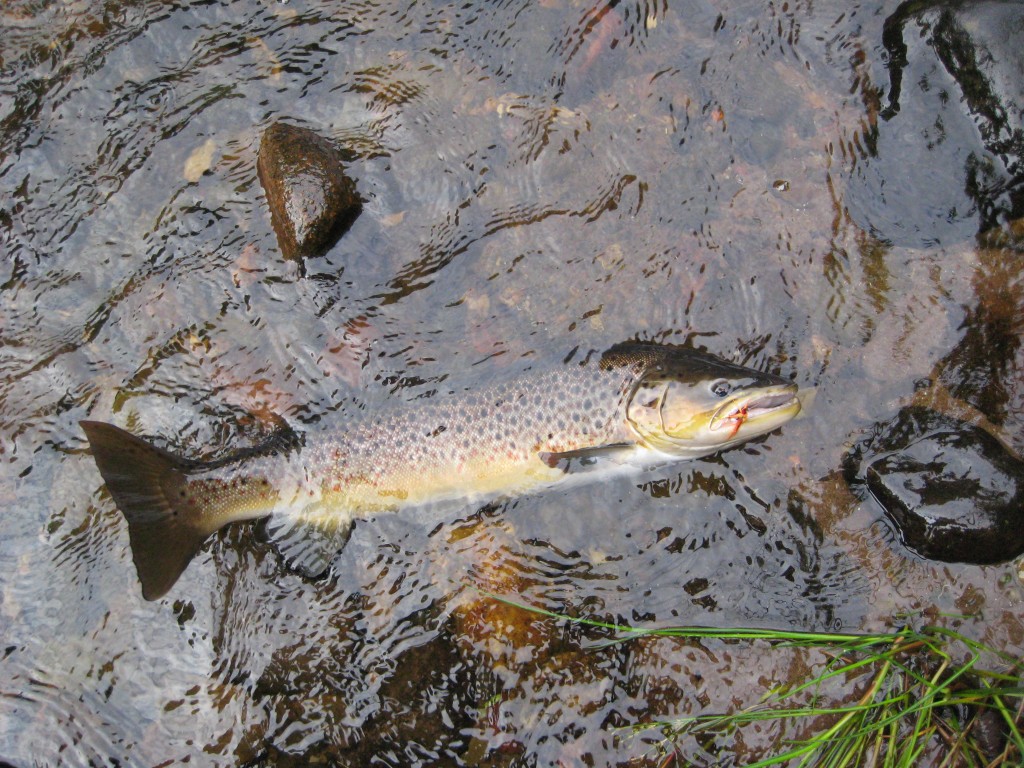
7lb Sea Trout from Craigo Stream Pool (Returned)

7lb Sea Trout from Craigo Stream Pool (Returned)

The 2010 Season: A Crystal Ball

Wednesday, December 9th, 2009

So, what can we expect in 2010? My view is that we should see the sea trout numbers continue to improve. I say this on the evidence of a big increase in terms of prey biomass around Scotland’s coast. This has been recorded by SNH and it appears that there is a similar trend in Ireland and Northern England. No-one is able to explain why there should be a sudden and unexpected increase in zoo plankton, phyto-plankton, sand-eels etc . What we can say however, is that further afield in the South Norwegian Sea, things are not looking so good with a collapse in herring, blue whiting and mackerel stocks. Interactions between salmon (and to a lesser extent in the open sea) and other species tell us a lot. To summarise; close to Scotland’s shores there seems to be plenty of food, but elsewhere the situation is at best patchy. Conclusion? OK for sea trout, not so good for grilse, and possible OK for 2 sea-winter salmon and the odd 3 sea-winter salmon that survives.

Melgund Pool on Indies Beat

Melgund Pool on Indies Beat

The Excitement of Anticipation

Monday, March 9th, 2009

This has been an old-fashioned, cold winter. The hills of Angus are still mainly white and the corries, especially on the North slopes, are filled with snow and ice. If the thaw continues slowly we should see water levels holding up, and this should make it easy for the spring salmon to enter the river and move well up into the catchment.

Derek releasing a kelt

Derek releasing a kelt

It has been an outstanding year for kelt survival. Derek Strachan who you can see in the photograph unhooking a well mended kelt from Indies Pool, caught 13 kelt in one busy morning in late February. But, as I write this in the second week of March, there are still no reports of fresh salmon being caught upstream of Brechin.

Now is the time when ghillies and fishery managers are preparing for the coming season’s visiting anglers, who come to the South Esk from all over the World. Huts are being painted, riverside seats and rod rests repaired and oiled and the first shoots of giant hogweed dug up or treated with weed killer. Pools are inspected to see what winter floods damage has occurred, foliage trimmed back, flood debris and litter removed from the banks and the river.

I often think of the early weeks of the new season as a kind of phoney war while we await the arrival of the oyster catchers, coming inland to select their breeding sites, and in their wake the spring salmon. At first it is the occasional swirl or blue-black back and iridescent silver flank that you might be lucky to catch sight of, but usually these secretive early running salmon make their presence felt (literally!) by a long-drawn solid tug at the deeply fished fly. That moment has yet to arrive in 2009, but with the river in superb condition, the water clear, deep and lots of it, we expect the first spring fish of the new season to announce its arrival any day now.

Fishing for salmon is largely the excitement of anticipation. There is nothing to compare with the expectation of the first new-season salmon, and this bulletin will report the event as soon as the first salmon of 2009 is caught and released alive into the river to continue upstream to lay its precious cargo of eggs in a tributary far up in the glens of Angus.